Showing posts with label canvas. Show all posts

Wednesday, 15 March 2017

Workshop in Tuscany June 3 - 10th


Improve your paintings while enjoying your vacation in Italy.


Discover how to paint a plein air in just 20 minutes.

Italy has always been the first choice location for artists who flock here from all over the world to experience the light, friendly people, good food and verdant Italian countryside. 

Tom J. Byrne will be demonstrating painting techniques to both beginners and more established plein air painters, using oils and watercolor this June 3rd - 10th in the beautifully converted Watermill at Posara along the river Rosaro. It offers very comfortable accommodation with a great chef, comfortable quarters and good company.

Painters will visit local beauty spots to explore painting opportunities with their easels and demonstrations will take place both in the villa and on site. From very quick study methods to more elaborate painting techniques. We will focus on composition. 20 minute painting studies in both oil and watercolor. Best practice in laying in a plein air painting. Under painting for plein air and alla prima in oil. How to use watercolor in wet on wet and color layers.

http://watermill.net/painting-holidays/painting-holidays-tutor-tom-j-byrne17.php


For more information visit the Watermill
http://watermill.net/painting-holidays/painting-holidays-tutor-tom-j-byrne17.php

Tuesday, 17 January 2017

Sketching while the winds howl and rains fall

While some hardy souls are out painting in the high winds, cold rain and flying sleet others are nesting down with their books, pencils, sketchpads and inks.

Winter is a great time to doodle and doodling shouldn't ever be taken for granted. It's a wonderful way to limber up and refresh those creative juices.

Here are a couple of studies from this week, which has been windy and wet here in Tuscany.

A series of imaginary portrait sketches in pencil and another is a study of an orchid which I've been house sitting while her owner is away.


Thursday, 1 September 2016

Painting San Niccolo along the Arno - Step by step en Plein Air.


Painting by Tom J. Byrne
Oil on canvas
12 x 16 inches / 30 x 40 cm
Location: Florence, Italy
http://www.tjbyrne.com

Introduction: 

The scene of the San Niccolo tower and the reflected morning light in the Arno is a popular one among artists and students of art, living in Florence. It pops out of the opposite riverbanks trees and is complimented by the remains of a mill at the weir opposite. The calmness in the water created by the weir creates beautiful reflections in the early morning and is best from 9am onwards. A civilized hour for a working artist to begin a painting.

The tower is illuminated while the trees are mostly in shadow and the waters reflections are like a slow moving ripple and are easily captured if the artist can work quickly and reduce them to their essence.

The first thing is to consider the changes in light which each day brings to the scene. Get involved by looking at the intensity of the light, clarity of sky, and strength of shadows. Look for colors in the darks but don’t try to reproduce them. Just be aware of them so that there is a tendency towards the colors in your darks. A hint of red or purple in the shadows can be your guide to the color tendency of the whole scene. Imagine how the scene is going to change by considering the position and direction of the moving sun. Try to animate that in your mind before you begin painting so that you can anticipate changes that are coming.

The painting process isn’t only about recording what’s in front of you. It’s about your response to it and if it doesn’t engage your imagination then the scene will be dull and uninteresting. When an artist feels that they have a connection they don’t worry so much about the details. They simply get into them as a process of painting. Having said that, experience and lots of painting practice help to get past the worry about ‘how’ to capture something that seems very complex and demanding.

So by way of ‘experience’ here are the steps I took in painting this scene.

Process:

1.

Consider the scene here and look at it as mostly shadows with clumps of light sticking out. The camera can’t capture the movement of the light or the ever changing reflections in the water, nor the light in the shadows which the naked eye can see.


My first step is to mark in the position of the shadows on the canvas which in this case I’ve given a toned ground of pinkish red as the season is beginning to move into autumn. I am using a burnt umber and cad red to paint in the shadows position and will supplement this with other colors later. I don't do a charcoal drawing. Just marks with the brush and erase with another brush loaded with some medium.

The lightest lights are added in the sky and the waters reflections. So with the shadow marked in and the lightest lights the largest blocks of light and dark are indicated, which helps to put the other values in context.

Then I block in the main colors which will influence the impression of the painting. Not worrying about details I focus on the the fall and turn of light and get in at least 3 bands of values in each large form. From the lightest to the middle to the darkest to give a sense of the turn of light on the trees, for instance. These are my notes and help with predicting the position of the light a little ahead of time.

I won’t discuss the composition as I’ve described that in other demonstrations. Although there isn’t a lot of perspective in this painting I’m making the far banks colors a little subdued so that we have a sense of aerial distance.

It’s important to note the intensity and position of the shadows in the main architectural elements at this point. They draw the eye in and will be important later. So make them a little more intense than you might think is wise.

2.


In the sky I’ve used a combination of cobalt, ultra marine, and a tiny bit of red mixed with white to make a greyish blue which moves from darker to lighter at the treeline. I like texture in the sky so am using a white from which I’ve removed a lot of the medium. I’ve painted in a lot of the foreground grass and it’s shadows. In the water I’ve very quickly describing the reflections at the edge of the far bank, the main lights reflected and the sense of movement.

So now you have the sky, the far bank which is mostly shadow, the water and the foreground. 4 bands of value intensity. This is done as quickly as possible without much detail. It’s all creates a frame for the tower and other architectural elements. If I were to paint in the architecture first, the chances are high that I would obsess on the details and not paint the shadows in the context of the nature surrounding it.

3.

The lights on the edges of the water on the far riverbank are important. They always exist when water meets shadow but don’t always have the same value.


4.

Now that the architecture is framed and the surrounding are in place I can paint the buildings. I have my shadows so only the main light planes remain. On the main face of the tower receiving the early morning light, the fall of light should be considered. Lighter at the top, darker as it descends. In this case I didn’t do that so the face looks a little flat. 

However the dark drawing peeks through at the edges which makes this acceptable. I didn’t paint a lot of detail in the shadows on the face of the tower. They are just suggested. Intense shadow moving to lighter. 3 bands of color value are used. The value in the shadow of the tower is painted over the red, which is allowed to show through. In the weir arches and butress’ to the right of the tower we see the fall of light and turn of light as the values go from high to low. I’ve increased the chroma here using the appropriate colors in white to compliment the shadows. If you look into the shadows of the trees you will see a light purple popping out of the dark shadow. This note of color describes the reflected light coming off the water. See the trees on the right over the weir. Under the line of riverbank trees you’ll see that I’ve just dragged a green shadow value over the dark red that was used to describe the position of the shadows under the trees.

5.

You can see here that the movement of the water is created by simply setting colors down beside each other in abstract forms. There is no attempt to describe ripples. The lights are a variety of intensities and red shows through where it is appropriate. It’s mostly the red which I painted to describe the shadows that we are seeing here. As the eye travels further across the water the more abstract the forms.
Now that the image context is in place and the architectural values are done I can add some more form and intensity to the shadows and lights. The focus is on values now. Making the forms which have already been described come alive without obsessing over details. If this were a studio painting, this would be called the second painting stage. You can see from the brushstrokes that I’m moving very quickly with the brush and respecting the position of the light without focusing too much on individual elements such as leaves except in the foreground tree which is slightly helps to emphasize the perspective.

In this image you get a better sense of the water and again can see that the red underpainting is peeking through, helping to create the sense of ripples and reflected shadow. Red and green are complimentary colors and one emphasizes the other so the shadows under the trees sing. By adding lights in the most eye catching forms on the far bank I lift the shadows.

6.


This side by side view of the painting and a photo gives a lot of information about the paintings progress. The sharp eyed will notice the photo is taken later in the process because the shadows are longer (sun is higher in the sky). This is why painting in the shadows first is very important. It unifies the painting before you begin to add color. I haven’t labored over detail. Just enjoyed the process of quickly observing everything I’m seeing and recording the vibrancy of light.

The painting gives the impression of realism but doesn’t attempt to record every line or brick and aerial perspective is very strong right here because I wanted to create the sense of trees falling away in the distance behind the weir using lighter values.


Painting © Tom J. Byrne 2016.


Monday, 4 January 2016

William Turners intriguing Seascape

While researching one of my favorite landscape painters, William Turner, I learned a little about the back story of one his seascapes which now resides in the John Paul Getty Museum.

I was studying his painting method when I noticed something odd about the painting and discovered that Turner was also a master of hidden messages.


Title: Van Tromp, going about to please his Masters / Getting a Good Wetting.
Painted in 1844 using oil on canvas on canvas. The painting measures 92.4 x 123.2cm.

Admiral Von Tromp

The scene, like many other great Turner paintings, has few defined details and almost no hard edges. Despite this there is enormous energy and our imaginations are swept up in the impression of waves crashing together. We imagine that we can see the sailors aboard and feel all the ships being battered about.

On closer examination that is true of one ship with a sailor tipping his hat to an audience looking out from other vessels. But the other boats are in calmer waters.

How does Turner create this contradictory visual impression in the same painting and why?

Lines:
Turner uses the patterns of lines very cleverly. The masts, twisting into the sky give the impression that all the near ships are being tossed about on the waves. They point into the sky in opposing directions as though they were on the crests of opposing, clashing waves. The waves in the foreground support that impression by rolling and cresting in dramatic fashion.


Closer detail:
When we look a little closer, following the view of the sailor we see that his audience are in fact in boats resting in very calm waters. They are also using oars, with no need for sails. So the sails are just for show. Turner has used them like a magician, to give the impression that all boats are in the same waters, together.


So what could this painting be telling us?
The military gun boat in the distance might offer a hint.

When the back story is known this scene makes some sense and it's clear that the painting contains a message.

The sailor tipping his hat is Admiral Von Tromp whom Turner was an admirer of. Von Tromp was dismissed from the Dutch naval service in 1666 after failing to follow orders. This failure would later prove to be his saving grace.

Quoting the J. P. Getty Museum:
"Van Tromp was reinstated in service and reconciled with his navy superiors in 1673. In perhaps a symbolic overture signaling his submission to authority, Tromp is shown, in Turner's words, "going about to please his Masters."

The warship in the distance suggests a threat of military enforcement and the people viewing from the ships in calmer waters may be his military superiors with the Dutch West Indian shareholders. So the painting, on closer examination is probably a story of political and commercial interests bringing an adventurous spirit to heel.

To learn more about the backstory, which is rippling with intrigue, follow this link & scroll down to the engraving of the St James day Fight. A short overview of the life story of Cornelis Tromp here.


Friday, 1 January 2016

Happy new year. Winter light in Tuscany

Happy New Year.
Here's wishing you a very happy, inspiring, artistic and creative 2016.

Exploring the Tuscan countryside is always amazing. Even in winter it's incredibly beautiful and full of surprises.

While exploring painting locations I recorded the setting sun in a rather beautiful location within easy walking distance of Florence. The photos below are all taken on the same day with a mobile phone on a tripod and I just thought you might enjoy them as they look more like early autumn, rather than the pinnacle of winter.

Hope you enjoy them.


#Tuscany #Florence #Firenze #Italy #painting #Landscape #oils #watercolor #drawing #art #workshop #paint #winter

Tuesday, 29 December 2015

Artists who paint in Italy - Mary Pettis

Mary Pettis is a plein air painter who visits Italy for it's magnificent Plein Air painting opportunities. 

Firstly, we would like to congratulate Mary for her recent award and fabulous painting which won 3rd place in the "En Plein Air Texas" Painting Competition. She painted this scene en Plein Air with no photographic reference, over a 4 hour period.

Her strategy for capturing this moving artistic feast was to know the goats eating habits in advance, where and when they were fed. She shows her process in her color sketch (see below). Laying in the important elements, separating light and dark forms on her canvas and positioning important objects. As a goat would move into a convenient position, she painted it in using very simple light and dark shapes. The completed oil painting is magnificent and it's amazing what can be achieved with a good plein air strategy.

Mary sitting with the 3 winning paintings. Hers is titled:
Breakfast at Treva's - oil by Mary Pettis.


The initial stage. Sketching in the main forms and shadows on the canvas, including the person in the distance.
The completed oil painting. Quiet spectacular. 


She also recently visited, Cinque Terre, Italy with a group of artists and I wanted to share some of her photos which describe the adventure. They give an idea of the great beauty, light and painting potential of Italy. Mary allowed me to share the following images and her descriptions below.


The artists waiting for the bus to Monterosso.

One hour sketch demo from the hotels garden terrace.
Moments of solitude...
This lovely Italian woman (seen above) popped open her window and started calling down to us in Italian; she was showing off her flowers and the beautiful steps up to her house (seen below). I asked if I could paint it for my demo and she was joyous! She went on calling down to me, pointing and telling me where I should stand to get the best view.
 When I was done with my 1 hour sketch, seen here, this lovely woman re-emerged asking to see the finished painting. I showed it to her and she gave me a huge smile and two thumbs up.


For more information on Mary and her art you can visit her blog at http://marypettis.blogspot.it/

Saturday, 26 September 2015

A special thanks

We were very lucky to have great helpers in this event and we'd like to thank them.

Chiara Perondi

Among the best was our brilliant housekeeper Chiara Perondi, without whom we would have been lost. She anticipated our every need and was a real part of the art family during the week. If you would like to contact Chiara for your private events you can find her on facebook at this Link.

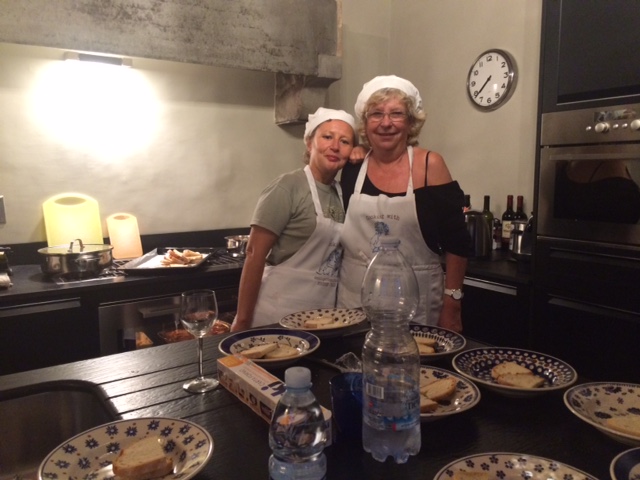
We were also blessed with fantastic cooks. We referred to them as our Italian Mamas. No fuss. Just beautiful food and great fun.

Cooking with Carlotta.


You can contact Carlotta through her website or her facebook page.

www.cookingwithcarlotta.com
https://www.facebook.com/cookingwithcarlottacom-530554536997385/timeline/

Friday, 18 September 2015

First Few days at the Villa

We've been painting at the villa for the last week and it's been quiet a pleasure as well as a great painting experience. The art guests have come from all over the world. Canada, the USA, Ireland and Australia and everyone is enjoying the experience as well as perfecting their art.

Guests have been very surprised by the quality of the experience. We're not blowing our own trumpet here, it's been the topic of conversation at many evening meals. Some of which have been in the villa and others in local restaurants. In the villa we owe thanks to our cooks and to the great assistance of Chiarra Perondi who has looked after the house every day while we've been painting.

We've visited the gardens of the Corsini Family as guests of Donna Georgiana Corsini who is also a painter. The original plan was to visit many different locations around Florence to paint but the fact is that everyone is so enamored by the location that no one wanted to leave, so we have mostly painted from the villa every day. It has amazing views and painting opportunities.

Here are a few photos from the last few days. We will be finishing up on Sunday. It's been a great experience so far and bodes well for future events.

Meeting for the first time in Florence before visiting Zecchis for art supplies. 
Our first evening at the villa. Eating on the terrace under the stars.
Our Australian artist, enjoying her visit to Florence.

Painting in the Corsini Gardens, Florence.

Choosing a view from the villa.

Explaining color mixing and values.

Very glad to have a watercolorist among us.

Color mapping a scene.

Our scholarship winner at work studying the landscape

In the Corsini Gardens

Wild tortoise wander all over the Corsini gardens. It's obviously a very old tradition.

Study of a statue in the Corsini Gardens.


A part of the panoramic view, every day.